Creation
Fragrance can be much more than just a perfume. We develop olfactory concepts for brands, products, spaces, and special contexts. From exclusive perfumes, signature scents, and artistic works to fragrance solutions for natural cosmetics, home care, and industrial applications.
You are developing or expanding a perfume brand
You are developing or expanding a perfume brand
Do you want to develop an Eau de Parfum or a fragrance line that precisely fits your project? Wilhelm Perfume creates tailor-made fragrances for new launches, range extensions, and repositionings. Perhaps you are also looking for a fragrance that seamlessly integrates into an existing product range. Together, we refine your brand's olfactory signature and define which fragrance world suits your product, target audience, and visual identity.
We work closely with your design, product, or marketing team and guide the development from briefing to final implementation. This also includes a careful assessment of which olfactory areas can be meaningfully addressed and further developed. Implementation is carried out in compliance with relevant regulatory requirements such as IFRA, EU CosReg, and CalProp 65 if applicable. Upon completion of the creation, we deliver the perfume oil directly to you or your contract manufacturer.
You are looking for a Signature Scent
You are looking for a Signature Scent
Do you want to make your brand values tangible through the senses and leave a lasting impression? Wilhelm Perfume develops fragrance signatures that create recognition, shape atmosphere, and embed themselves in the memory of your target audience.
The creation is based on your CI, your identity, and the definition of your core values, which we jointly identify for their emotional impact in the first step. The fragrance is then developed in close collaboration with your team and tested in real-world application contexts. Various technical solutions are available for implementation, from simple scent diffusers to outsourcing maintenance and care to a specialized partner company. A broad network is also available for scented giveaways and complementary applications.
You are Working on an art project with scent
You are Working on an art project with scent
Are you an artist or working on an exhibition, installation, or performance format and want to use scent as an artistic medium? Wilhelm Perfume develops olfactory concepts for art projects that are not only compelling in content but also technically precise in execution.
With the necessary expertise, we guide the process from the initial idea to its concrete application in a space. We develop the fragrance, define the appropriate method of diffusion, and ensure it is perceptible where it is intended to have an effect. Numerous completed projects and various technical solutions form the basis for this. We view such work as collaborations. Andreas Wilhelm is not only the executing fragrance developer but is also credited as an artistic contributor where artistically justified.
you are Working with natural cosmetics
you are Working with natural cosmetics
Do you want to develop a fragrance for cosmetic products that complies with your natural cosmetics guidelines? Wilhelm Perfume supports natural cosmetics projects with exceptional experience and care. Since his time at Weleda, there has been a strong connection to this field and a keen sense of what is possible with natural raw materials today.
Depending on the specifications, we work exclusively with essential oils, natural isolates, or an extended range of nature-based and biosynthetic raw materials. The goal is always a fragrance solution that is natural, modern, and technically convincing. We develop the perfect blend for your product and deliver the finished fragrance composition along with the standard documentation in accordance with relevant guidelines.
You are planning a workshop or a private fragrance project
You are planning a workshop or a private fragrance project
Would you like to conduct a perfume workshop with your company or as a private individual? For this, we have developed a workshop that can be booked at The Notes in St. Gallen. It was important to us that participants not only learn about fragrance but can also create a real and wearable Eau de Parfum.
For this purpose, a selection of perfume bases has been developed that can be individually personalized with various raw materials during the workshop. When booking through The Notes in St. Gallen and entering the code XXWILHELMXX, you will also receive a sample of your choice from our house brand.
Furthermore, we also selectively review selected private fragrance projects within an appropriate framework.
You are an industrial partner or perfume house
You are an industrial partner or perfume house
Are you a perfume house or industrial partner looking for support in developing fragrances for industrial applications or in general? As an independent perfumer with an industrial background, Andreas Wilhelm has worked with a wide variety of companies, always with an eye on the bigger picture.
In addition to strategic assistance, Wilhelm Perfume has a wide range of existing formulations for various applications, from personal and home care to household and air care, and alcoholic perfumery. These can serve as market-ready starting points for new creations or as a basis for the sound further development of existing concepts. We are also available if you are looking for an independent yet industrially-minded second opinion. Andreas Wilhelm has three decades of experience in the fragrance industry and has built up extensive expertise in various areas.
Among the companies that have already been advised or supported are Weleda Naturkosmetik CH/DE, Seluz, Sensient Fragrances, Eurofragance, Scentronix, and Primavera Naturkosmetik.
Process
Many people enjoy a beautiful fragrance every day — but few know how a perfume is truly created. From the first spark of an idea to the finished bottle, it's a fascinating process that combines creativity, craftsmanship, and scientific expertise.
creativity, craftsmanship, and precision
briefing
Every fragrance creation begins with a briefing. This usually includes a mood board, a description of the brand or the desired fragrance character, and, if helpful, market references. This creates a clear, shared understanding of the direction, application, and goal.

Idea
The olfactory concept is developed from the briefing. The look and feel are refined and translated into an initial fragrance idea. Based on this, the creative work on the formula begins.
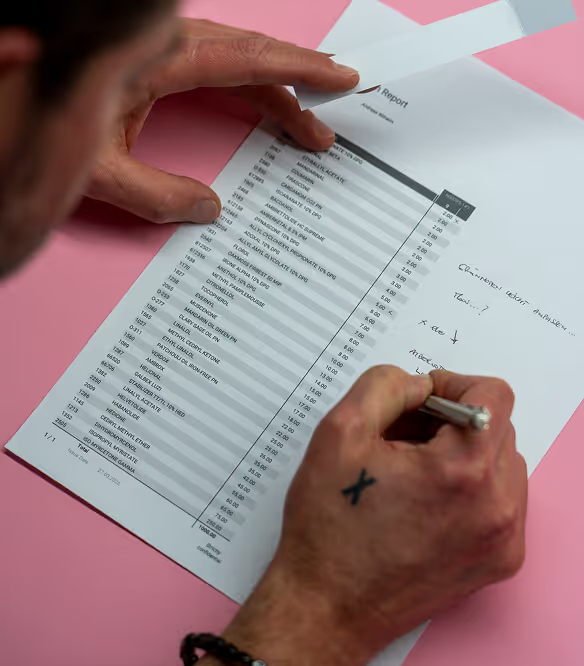
Raw Materials
Approximately 1800 raw materials are available for creation. These include natural raw materials as well as nature-based and synthetic molecules. A perfume usually results from the precise interplay of these different groups.
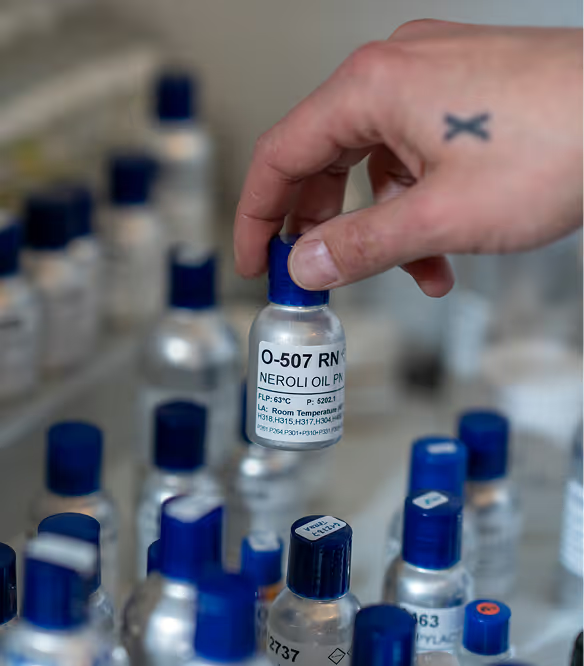
Composition
Using a precision scale, initial variations are blended, evaluated, and further developed. From basic accords, fragrance compositions emerge, which are refined step by step. We iterate together until the character, effect, and balance are perfect.
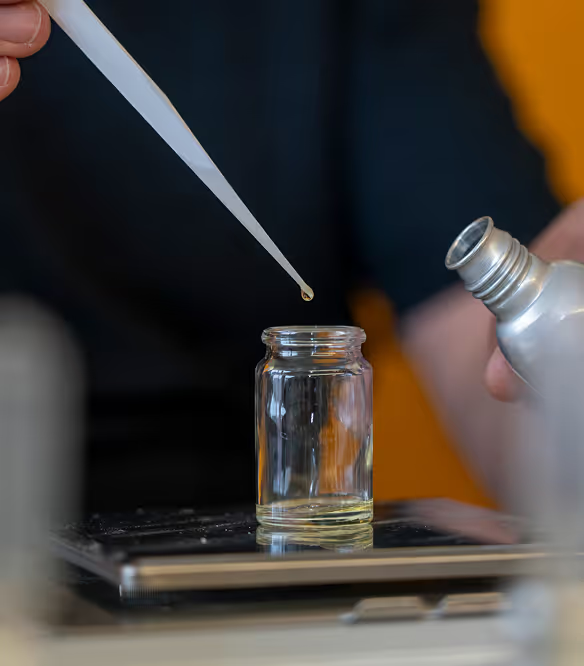
Regulatory & Safety
Before a fragrance is finalized, the relevant regulatory and safety requirements must be met. Testing is carried out according to common standards such as IFRA, European cosmetic regulations, and other local requirements, depending on the target market and application.
Production & Maturation
After finalization, the perfume oil is produced. For alcoholic perfumes, this is followed by dilution with perfumer's alcohol and distilled water. During the maturation period, the individual components combine to form a harmonious overall structure.
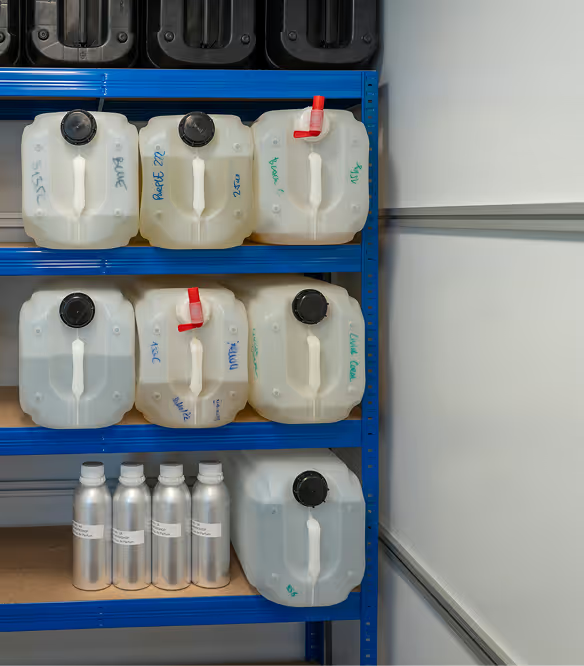
Bottling & Quality
After maturation, the fragrance is ready for bottling. Smaller batches can be hand-bottled in Zurich, while larger quantities are handled by production partners. Before delivery, final quality checks are performed to ensure both the product and its presentation are equally impressive.
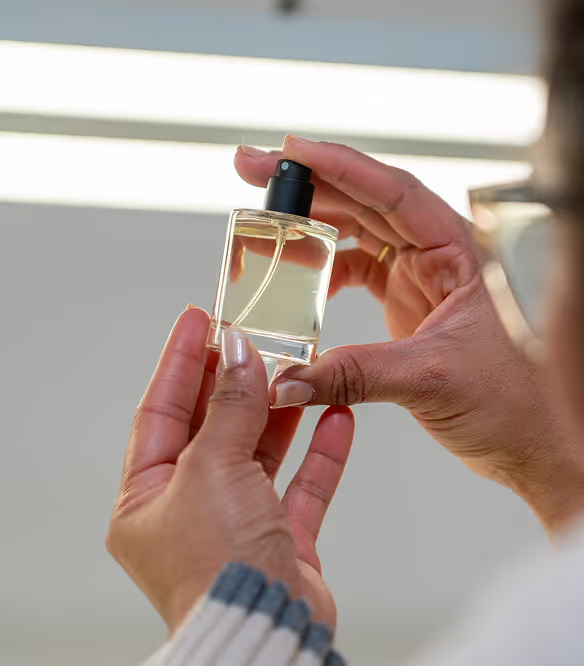
Developing a fragrance is a precise process. What later seems effortless is born from experience, imagination, and countless careful decisions. From the initial idea to the finished product, months often pass during which composition, raw materials, application, and effect are meticulously coordinated step by step.
FAQs
Fragrance Knowledge
Here we answer key questions about fragrance development, signature scents, natural cosmetics, regulation, and collaboration. Not as an encyclopedia, but from Wilhelm Perfume's practical experience.
Process & Projects
Wilhelm Perfume supports fragrance projects in various contexts, from eau de parfum and fragrance lines to signature scents, natural cosmetics, art projects, workshops, and industrial applications. What's crucial is not so much the category, but the quality of the inquiry: We are looking for projects with clear aspirations, precise objectives, and the willingness to take fragrance seriously as an independent medium.
A good brief doesn't just describe how a fragrance should smell, but also the context in which it functions. Information about the brand, target audience, application, desired effect, market environment, and any references is helpful. Technical or regulatory requirements should also be considered as early as possible. The clearer the brief, the more precisely the olfactory direction can be developed.
Yes. Depending on the project, we deliver the perfume oil directly to you or your production partner. It is also possible to integrate existing development or production structures into the process. Especially in the B2B sector, this collaboration is often beneficial because creation, implementation, and production can be precisely coordinated.
Wilhelm Perfume can develop fragrance compositions exclusively for a brand or company. Typically, the client receives the exclusive marketing and usage rights for the developed composition, while the formula itself remains the property of Wilhelm Perfume. This separation is not uncommon in perfumery and ensures that exclusivity and quality can be reliably managed in the long term.
Generally, yes. A complete IP transfer is possible, but significantly more complex than merely using an exclusively developed composition. The reason is that a formula does not automatically smell identical when produced by a different manufacturer. Differences in raw material qualities, sourcing, and production conditions can noticeably alter the result. For a fragrance to remain precisely preserved after a transfer, additional documentation, coordination, and in many cases, technical re-implementation are required.
Both. In addition to new developments, we also support repositioning, range extensions, olfactory refinements of existing lines, and reformulations of existing products. Especially for established brands, it is often valuable to evolve the existing fragrance language rather than reinventing it.
Development & Creation
Every development begins with a briefing and a clear objective. This leads to an olfactory concept, which is then translated into initial formulas. Variants, evaluation steps, and further iterations follow until character, effect, and technical feasibility harmoniously come together. Depending on the project, regulatory checks, production, maturation, and quality control are then integrated.
That depends heavily on the project. A clearly managed development with a precise briefing can be completed in a few months. More complex projects with multiple iteration loops, international requirements, or demanding technical specifications require significantly more time. Fragrance development is not a quick process, but rather one of precision, experience, and coordination.
Fine Fragrance is primarily a wearable scent, usually as an Eau de Parfum or Extrait. A Signature Scent is an olfactory identity for a brand, a place, or an experience. Functional fragrance applications, on the other hand, are developed within a clear application context, for example, in body care, home care, air care, or natural cosmetics. While the creative approach is similar, the requirements for effect, technology, and application differ significantly.
The fragrance pyramid remains a helpful model for describing the progression of a scent. It distinguishes between top, heart, and base notes, making it clear how a fragrance unfolds over time. However, for the actual creation, it is only one part of the whole. What's crucial is not the schema, but how a fragrance performs as a complete composition.
A fragrance must not only prove itself in the lab, but also where it will actually be experienced. Therefore, its effect and behavior are always tested within the application context: on the skin, in a room, in a product, or in combination with a specific carrier material. This real-world testing is particularly crucial for signature scents and functional applications.
Raw Materials, Quality & Regulation
With both. For creation, natural raw materials are available, as are nature-based and synthetic molecules. A good fragrance is not born out of ideology, but from the quality of the composition. What matters is which raw material provides the desired effect, stability, and technical suitability in a given context.
Synthetic molecules significantly expand the perfumer's palette. They enable fragrance effects that are limited or non-existent in nature, and they often allow for better stability, precision, and reproducibility. Modern perfumery therefore almost always works with an interplay of natural and synthetic components.
Natural cosmetics require a different set of decisions. Depending on the standard or brand philosophy, we work exclusively with essential oils, natural isolates, or an extended range of nature-based and biosynthetic raw materials. Simultaneously, naturalness, scent, skin compatibility, stability, and regulatory requirements must be harmonized. It is precisely this balance that makes natural cosmetics challenging and interesting.
This depends on the target market and application. Relevant standards and regulations include IFRA, European cosmetic regulations, and potentially other local requirements. For international projects, these specifications must be considered early on. Regulation is not an afterthought; it's an integral part of professional development from the outset.
IFRA defines safety standards for the use of certain fragrance ingredients in various applications. These guidelines help minimize risks and ensure products are safe and marketable. In practice, this influences both the formulation of new fragrances and the revision of existing recipes.
After final approval, the perfume oil is produced. For alcoholic perfumes, this is followed by dilution with perfumery ethanol and distilled water, as well as a maturation period during which the components harmoniously blend. Afterwards, filtration, filling, and quality control take place. Depending on the project, these steps are carried out in Zurich or with production partners.
Quality is evident not only in the fragrance itself but also in its stability, reproducibility, and technical execution. Therefore, depending on the project, the process includes analysis certificates, stability tests, safety assessments, optical inspections, and leak tests. This ensures that the product performs well even after production, transport, and application.
In practice, the result depends not only on the formula but also on the quality and characteristics of the raw materials used. This applies to both natural and synthetic components. Two manufacturers can formally work with the same recipe and still achieve slightly different results. Especially with sophisticated fragrance compositions, experience in implementation is therefore just as important as the recipe itself.
Signature Scents & Applications
A Signature Scent is a specially developed olfactory signature that makes a brand, place, or experience uniquely recognizable. Unlike a classic perfume, it is not primarily intended as a personal fragrance, but rather as a sensory extension of an identity. It creates recognition, atmosphere, and emotional anchoring.
Signature Scents are used in retail, hospitality, exhibitions, showrooms, brand spaces, events, or as part of a product experience, among other applications. Depending on the context, the scent can subtly permeate a space, be associated with a giveaway, or become part of a larger multi-sensory concept.
The development is based on the brand's identity, its values, and the specific application context. Together, we define the desired effect of the scent – whether it should be calming, distinctive, warm, surprising, clear, or emotionally charged. This forms the basis for initial directions, which are then refined and tested in a real-world environment.
Yes, but not as a simplistic translation of individual adjectives. A good signature scent doesn't arise from buzzwords, but from a precise understanding of brand, space, target audience, and mood. Fragrance works where language and images often fall short. Precisely for this reason, it must be developed carefully and with nuance.
Workshops & Private Inquiries
Workshops are suitable for companies, teams, clients, communities, or groups who want to not just theoretically understand fragrance, but experience it directly. They provide a sensory introduction to perfumery and make it understandable how fragrance can be composed, perceived, and individualized.
A workshop format has been developed that can be booked at The Notes in St. Gallen. The goal was to create a format where participants not only learn about fragrance but can also create a genuine and wearable Eau de Parfum. This involves working with curated perfume bases that are individually personalized.
Selected private fragrance projects are generally possible, provided that the scope, objectives, and format align with Wilhelm Perfume's working methods. Such inquiries are reviewed selectively. The focus is not on short-term individual requests, but on coherent projects with creative and substantive aspirations.
Private projects are generally viable from a minimum quantity of 300 bottles. This threshold is due to the effort involved in development, implementation, and production. For smaller, experience-oriented formats, a workshop is often the more suitable starting point.